
A patient came into a partner community health center for a routine medical appointment. She had no dental appointment that day, but her health center offered preventive dental services inside the medical visit. During the visit, an OroMed MA captured images of her mouth, and an OroMed dentist found a lesion on her tongue that had been there for eight months without anyone noticing. She was referred to an oral surgeon, biopsied and diagnosed with squamous cell carcinoma.
With oral cancer, timing matters. According to the American Cancer Society, the five-year relative survival rate for tongue cancer is 88% when it is found while still localized, and 39% once it has spread to distant parts of the body.
Her lesion was found because the evaluation happened during the medical visit she had already come in for. This post walks through how OroMed adds that evaluation to medical visits at community health centers, step by step, and what it asks of the health center.
Why preventive dental services belong in the medical visit
Health centers see patients regularly for diabetes care, blood pressure checks, prenatal care and well-child visits. Many of those same patients rarely reach the dental side, even when the dental clinic is down the hall. A separate dental appointment can mean another day off work, another ride and another round of childcare.
In California, the gap is wide. In 2018, the state Department of Health Care Services reported that fewer than one in four adults on Medi-Cal had seen a dentist in the past year.
When dental problems go untreated, many end up in the emergency department. CDC data show that tooth disorders accounted for about 1.9 million emergency department visits a year in the United States from 2020 to 2022, and Medicaid was the expected payer for 55% of them. Adults ages 25 to 34 made the largest share of those visits, at 29%. Those are working-age adults, the patients for whom another day off work is hardest to arrange. An emergency department can treat the pain, but it isn’t set up to provide dental treatment.
Oral health problems often develop before a patient notices symptoms. The medical visit is an appointment the patient is already keeping, which makes it a practical place to offer preventive dental services.
How OroMed delivers preventive dental services during the visit
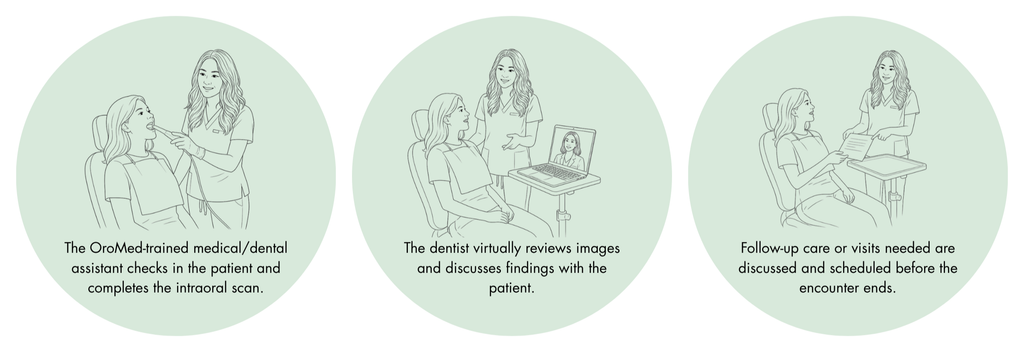
OroMed adds a dental evaluation to the medical visit. It takes about 6 to 8 minutes and follows the same four steps every time. Here is who does what at each step:
- Images. An OroMed MA captures intraoral images of the patient’s mouth.
- Evaluation. An OroMed dentist, credentialed with the health center, performs the evaluation through teledentistry and makes recommendations.
- Documentation. The OroMed MA writes the findings and the dentist’s recommendations into the health center’s EMR.
- Referral. Patients who need treatment are referred to the health center’s dental department.
For the patient, nothing about the medical visit changes except those few extra minutes. There is no second appointment to book and no second trip to make. The evaluation happens while the patient is already in the exam room.
Each step has one owner. The MA handles images and documentation, the dentist makes the clinical call, and the health center’s dental team owns treatment.
What the health center provides
No health center staff do any work for an OroMed evaluation. Your MAs keep their current duties, and your medical providers keep their schedules. OroMed brings its own MAs and its own dentists to deliver preventive dental services.
Every health center that partners with OroMed agrees to three things:
- Access to its EMR, so findings are documented where the health center’s clinicians already look.
- A point of contact on the health center’s side.
- Clinical workspace for the evaluation.
What your dental department does
OroMed’s preventive dental services identify the patients who need care. The dental department keeps ownership of treatment. When a patient is referred, the dental team reviews treatment options, creates the treatment plan and tracks the patient’s treatment. OroMed does not provide treatment.
When the dental team reviews a referral, it can see what the OroMed dentist found and recommended during the medical visit. That handoff, from the medical visit to the dental chair, is where medical-dental integration happens.
Many of these referrals are patients the dental department wasn’t seeing before. For a patient who hasn’t seen a dentist in a long time, the referral can be the first step back into dental care. That makes appointment availability part of planning. Before launch, it’s worth talking with your dental director about how many new patients the schedule can absorb, so referred patients have appointments to go to.
Billing and reimbursement
OroMed bills per patient which is a set amount for each preventive dental evaluation completed. OroMed doesn’t take a share of revenue or a percentage of collections. Reimbursement for the health center depends on your state’s rules and your payment arrangements, so we cover it one health center at a time on the Discovery Call.
See how it would work at your health center
The patient with the tongue lesion was already in the building for a medical visit. To walk through how preventive dental services would run at your sites, book a Discovery Call with our team.